W-4Water · roof tanks
Who checks the water tank on your NYC roof?
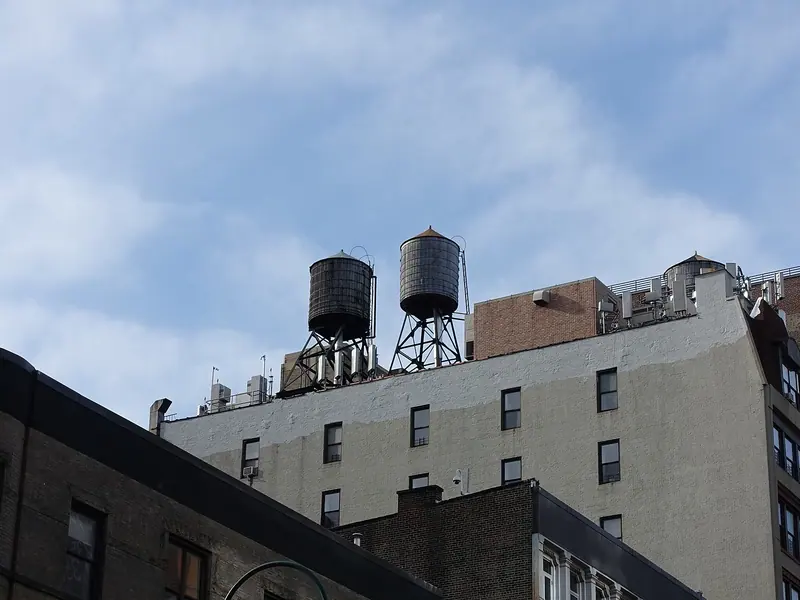
NYC roof water tanks must be inspected, with a bacteria sample, every calendar year, and the owner’s inspector must file the results with DOHMH by January 15.
Which building is yours?
- Prewar walk-upDOHMH ties roof tanks to buildings over six floors, so most walk-ups have none. If yours does, the owner must inspect it every year.
- Brownstone or row houseRarely relevant: DOHMH links roof tanks to buildings over six floors, and a row house is far shorter than that.
- Co-op or condo high-riseThe co-op board must have the tank inspected and sampled every year and post a framed notice saying where residents can see the results.
- Two-family houseRarely relevant: a two-family house is well under the six-floor height where DOHMH says pumps and roof tanks come in.
- New-build condoWhere a tower stores drinking water on the roof, the condo board answers for the yearly inspection; search the building’s address to see.

Which building are you in, and does it have a tank?
Height decides it. DOHMH explains that in buildings over six floors, pumps push water up to tanks on the roof (DOHMH tank reporting). That makes tanks a feature of the co-op or condo high-rise and of taller new condos. A typical walk-up or brownstone gets its water at street pressure. If your roof holds a drinking water tank, these rules apply to your owner.
Legend: the numbers on this plate
- 1inspection with bacteria sample per calendar year, at leastNYC DOHMH
- Jan 15deadline to file last year’s resultsNYC DOHMH
- 5 yearshow long owners keep inspection reportsNYC Health Code §141.07
- $500penalty for not filing by January 15 ($1,000 on default)NYC Health Code Ch. 31
What must the owner do every year?
At least once between January 1 and December 31, the tank must be inspected and a water sample taken for bacteria. The certified inspector then files the report with DOHMH by January 15 of the next year. Inspectors must be licensed master plumbers, people working under one, or licensed engineers or architects. The rule is Health Code §141.07 (Health Code Article 141). The owner keeps each report for five years and must hand it to DOHMH within five business days of a request.
How often must a tank be cleaned?
There is no fixed cleaning schedule in the Health Code. A tank must be cleaned when an inspection finds a bacteria problem caused by the tank’s condition, or when DOHMH orders it. Any unsanitary condition must be corrected right away, and a failed bacteria result must be reported to DOHMH within 24 hours. Cleaning, painting and coating need a DOHMH permit and a qualified firm under §141.09. So a building that says "we clean every year" may be doing more than the code asks, which is fine, but the yearly inspection is the legal floor.
| Building | Likely to have a roof tank? | Who answers for it | What a resident can do |
|---|---|---|---|
| Prewar walk-up | Rarely; most are six floors or under | Landlord | Look up the address; ask for the report |
| Brownstone or row house | No | — | Nothing to check |
| Co-op or condo high-rise | Often | Board and property manager | Read the posted notice; ask for a copy |
| Two-family house | No | — | Nothing to check |
| New-build condo | Depends on height and design | Condo board | Search the address or BIN |
How do you see your own building’s results?
Search DOHMH’s online results by street address or by Building Identification Number (BIN). Results are self-reported by owners or their inspectors, so a missing year is itself worth asking about. DOHMH says all filed results are public. The owner must also post a notice in a frame with a clear cover, somewhere residents can reach. It must say the results are available and give a name, address and phone number for getting them. Any resident who asks must get a copy within five business days.
Look up your own building
- DOHMH rooftop tank inspection results · your building’s filed inspection and sample results, by address or BIN
- ZoLa · your lot’s building details, such as the number of floors
- HPDONLINE · open housing violations and the registered owner or manager to ask
What if the tank was not inspected, or the water looks wrong?
Ask the owner or board for the latest report first; they must give you a copy within five business days. If no report exists, or the posted notice is missing, you can report it to the city through 311. The Health Code penalties are $500 for failing to inspect and test, $500 for not filing by January 15, and $250 for not posting the notice (Health Code Chapter 31). If the water suddenly changes color or smell, tell the owner and 311 at once rather than waiting for the next inspection. Other questions about city water are on tap water quality and the water hub.
Questions people ask
Does the tank rule cover hot water heaters?
No. The tank rules cover tanks that store drinking water. The building’s domestic hot water system sits outside them.
Who can inspect the tank?
A licensed master plumber or someone working under one, or a licensed professional engineer or registered architect. They file the report with DOHMH.
Is a yearly cleaning required?
No. The code requires a yearly inspection and bacteria sample. Cleaning is required when a sample fails because of the tank’s condition, or when DOHMH directs it.
Can a renter get the report?
Yes. Any resident can ask, and the owner must provide a copy within five business days. The posted notice tells you who to ask.
Are the online results checked by the city?
They are filed by owners or their inspectors. DOHMH makes them public, and that public record is what keeps late or missing filings visible.
How this plate was drawn
Inspection, filing, notice and record rules come from DOHMH’s reporting page and Health Code Article 141, and penalties from Chapter 31, all checked 11 Nov 2026. Chapter 31 shows no effective date for its penalty schedule. The online results tool loads by script, so we could not test a search. We did not find a city count of roof tanks.
Sources
- NYC DOHMH — Drinking Water Tank Inspection Reporting · yearly inspection, January 15 deadline, who inspects, online lookup · checked 11 Nov 2026
- NYC Health Code — Article 141 · records, posted notice, cleaning, 24-hour reporting · checked 11 Nov 2026
- NYC Health Code — Chapter 31 penalties · filing, testing and notice penalties · checked 11 Nov 2026
- NYC DOHMH — Rooftop Drinking Water Tank Inspection Results · public results lookup · checked 11 Nov 2026
Plate W-4 · revised 11 Nov 2026