H-6Heat · banging radiators
Why do steam radiators and pipes bang?
Banging radiators and clanging steam pipes are usually water hammer: water left in the pipes gets picked up by fast-moving steam and slams into a bend, valve or the end of a line.
Which building is yours?
- Prewar walk-upCommon in old steam walk-ups. Tell the super or owner when it bangs and where; heat that also drops below the minimum is a 311 complaint.
- Brownstone or row houseIn an owner-occupied house, have a licensed plumber or heating pro look at venting, boiler water and piping. Renting a floor? Tell the owner.
- Co-op or condo high-riseBanging in a riser or main is a building system: report it to the super with times and floors. The board and management decide on repairs.
- Two-family houseThe owner’s boiler, the owner’s call: the tenant reports the noise and any cold rooms; the owner brings in a licensed plumber or heating pro.
- New-build condoUnit-by-unit heat pumps or fan coils don’t water-hammer this way. If your condo has steam, tell building management.
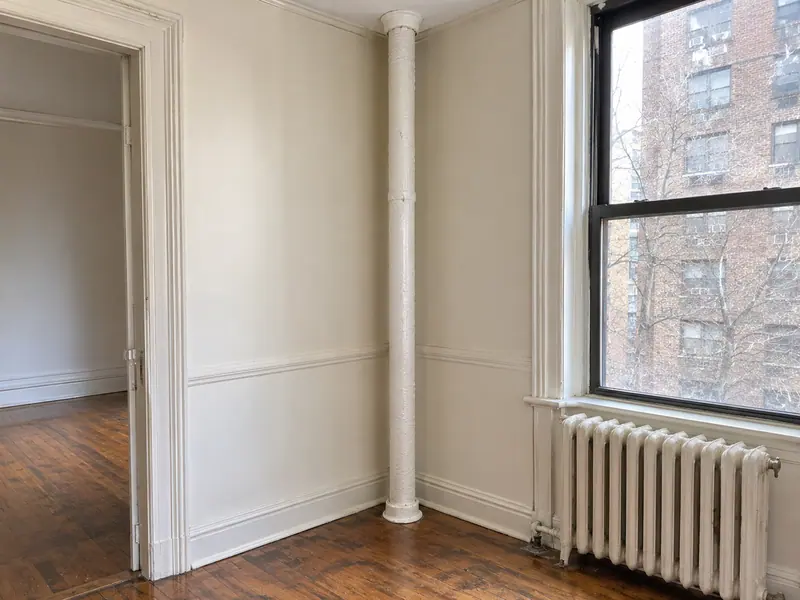
Steam heat makes some noise as it warms up, but a sharp bang, like a hammer on the pipe, is a sign that water is in the wrong place. In a steam system the water that forms as steam cools is supposed to drain back to the boiler. When it pools in a pipe and fast steam catches it, it is thrown along the line until it hits something. The US Department of Energy’s steam balancing guide calls this water hammer: the water is "carried by the steam and slams into the end of the line" (US DOE Building America guide).
Why do old New York steam systems clang so much?
The city’s own retrofit program says many steam-heated buildings suffer from "loud, clanging pipes", along with leaky radiators and flats that are too hot and too cold at once (NYC Accelerator one-pipe primer). It traces this to piping laid out for coal boilers about a century ago. Today’s oil and gas burners heat faster, many systems have too few air vents for that, and plenty of boilers are more than double the size needed.
That matters most in prewar walk-ups and older co-op high-rises, where one boiler serves every apartment and a fault in the basement can be heard on the top floor.
What causes water hammer in a steam pipe?
Several things can leave water sitting where steam travels. The sources we use name these:
| Cause | What it means | Named by | Who deals with it |
|---|---|---|---|
| Radiator valve half closed | Water can’t drain out of the radiator, so steam and water fight in the pipe | US DOE Building America | Super or licensed pro; valves are open or closed, not in between |
| Failed steam traps (two-pipe) | Water backs up into the steam main | US DOE FEMP | Building staff or a licensed pro |
| Oil or dirt in boiler water | Boiler surges and throws water into the mains | Weil-McLain | Qualified service technician skims the boiler |
| Water line set too high | Water carried into the steam pipes | Weil-McLain | Qualified service technician |
| Too little venting, oversized boiler | Steam moves hard and unevenly | NYC Accelerator | Owner, through a heating contractor |
On valves the DOE guide leaves no room: a radiator valve is meant to sit all the way open or all the way shut, and residents are asked to leave it alone. Set halfway, it holds condensate inside the radiator. Weil-McLain’s troubleshooting table lists "violent waterline fluctuations" and water passing into the steam mains, and sends each fix to a qualified service technician (maker’s boiler manual).
Is a banging radiator dangerous?
It can be. The federal energy management program’s operations guide says water hammer’s damage comes from the speed of the steam, not its pressure, so it can be as damaging in a low-pressure system as in a high one, and its force "can blow out a valve or a strainer" (US DOE FEMP O&M guide, chapter 9). The DOE balancing guide adds that the shock can crush the float inside a main-line air vent.
Legend: the numbers on this plate
- 120 ft/show fast slugs of condensate can travel in some steam linesDOE operations guide
- Oct 1 – May 31the heat season the city enforcesNYC311
- 68°F / 62°Fday and night indoor floors while the heat is on§27-2029 as written
Before calling about banging, what is worth writing down?
The super or heating pro needs to know where and when. A good note covers:
- the room and radiator, or the pipe in the corner where it bangs;
- the time it starts, and whether it is when the heat first comes up;
- whether that radiator stays cold, heats at one end, spits water or hisses;
- whether the radiator valve looks fully open, without turning it;
- whether neighbours hear it too, which points to a riser or main.
In a rental, give this to the super or owner. If the apartment is also below 68°F by day when it is under 55°F outside, or under 62°F overnight during heat season, it is a heat problem as well as a noise problem (HPD heat rules), and 311 is the next step.
Who fixes banging pipes in your building?
Whoever controls the boiler. In rentals and two-family houses that is the owner, and in co-ops and condos it is the board, through management and the super. Owners of a brownstone or row house hire their own pro. DOB treats piping as work for a Licensed Master Plumber, or a crew that one supervises directly, and boiler work as needing a permit or a licensed installer (permits and plumbers). If a cold radiator comes with the noise, see cold radiator.
Look up your own building
- HPDONLINE · whether your building already has heat complaints or violations on file
- DOB License Search · whether the plumber an owner hires holds an active license
Questions people ask
Is banging itself a housing code violation?
The city heat rules we found are about indoor temperature, not noise. If banging comes with too little heat, report the temperature. Repeated heat interruptions can count as harassment, according to 311.
Why does only one radiator bang?
A radiator whose valve is half open, or that holds water it can’t drain, can bang on its own while the rest of the building is quiet. Tell the super which one it is; don’t adjust the valve yourself.
Does banging mean the boiler might explode?
Our sources don’t say that. They say water hammer can damage vents, valves and strainers. If anything leaks steam or water, keep away and report it straight away.
Will bleeding the radiator stop the banging?
Steam radiators have air vents that let air out on their own and close when steam arrives, so there is nothing for a resident to bleed. Never open, cap or remove a vent; a hissing or spitting one is something to report.
Can a new boiler fix it?
Sometimes part of it. The Accelerator says a replacement boiler should be sized to the distribution system, but it also lists venting, controls and boiler water cleaning as part of the fix.
How this plate was drawn
Based on the NYC Accelerator’s one-pipe primer, the DOE Building America balancing guide, the federal FEMP operations guide (2010), a Weil-McLain boiler manual and HPD and 311 pages, all checked 11 Nov 2026. We could find no primary source on radiator pitch or slope, so there are no figures for it here. Banging in hot-water (hydronic) systems is a different subject and is not covered.
Sources
- US DOE Building America — Measure Guideline: Steam System Balancing and Tuning · water hammer at the end of a main, radiator valves fully open or closed · checked 11 Nov 2026
- US DOE FEMP — Operations and Maintenance Best Practices, chapter 9 · velocity, not pressure; blown valves; failed traps · checked 11 Nov 2026
- NYC Accelerator — One-pipe steam tech primer, 2019 · clanging pipes, coal-era design, oversized boilers · checked 11 Nov 2026
- Weil-McLain — SGO steam boiler manual, troubleshooting · surging, priming and skimming by a technician · checked 11 Nov 2026
- HPD — heat season minimums and statistics · 68°F and 62°F, complaint count · checked 11 Nov 2026
- 311 article KA-01036 on residential heat complaints · repeated heat interruptions as harassment · checked 11 Nov 2026
Plate H-6 · revised 11 Nov 2026