B-2Building · brownstone
Owning or renting in a brownstone or row house
In a brownstone or row house, the owner holds the boiler, the pipes and the bills, and which city heat and gas rules apply depends on how many families live there and whether any of them rent.
- Heat comes from
- The house’s own boiler in the cellar, feeding steam or hot-water radiators
- Who controls the boiler
- The owner controls it and hires a licensed heating pro or plumber for any service or repair
- The rule that matters most
- Rent out any unit and HPD’s heat and 120°F hot water minimums apply to that tenant (Admin Code §27-2028, §27-2031)
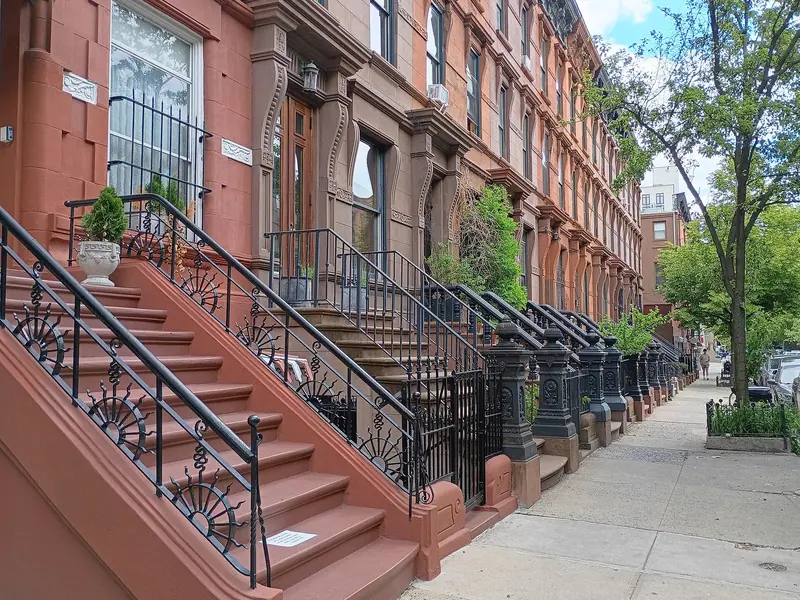
A brownstone or row house is an attached house on a shared-wall block, typically a few storeys over a cellar, holding one family or a handful. Unlike a walk-up, it usually has a single owner who lives there or nearby and pays for every repair. The question that sorts out the rules is simple: how many households live here, and does anyone pay rent?
Where does the heat come from here?
A brownstone heats itself: its own cellar boiler sends either steam or hot water to the radiators. A steam boiler has a gauge glass showing its water level and a pressure gauge; the Weil-McLain manual for one oil-fired model says typical one- and two-pipe steam systems need less than 2 psig. A hot-water system carries heated water to the radiators instead of steam. If you are unsure which you have, ask the heating pro who services it; our pages on one-pipe steam and two-pipe steam show what each looks like.
Who controls the boiler?
The owner controls the boiler, and anything beyond looking at it belongs to a licensed pro. The same maker’s manual gives owners a short list: keep the boiler area clear of anything that burns, and look over the unit for leaks or loose flue pipe. It sends annual service and any air vent or trap work to a qualified service technician. DOB adds that no boiler work can be done without a permit or a licensed oil burner installer or Licensed Master Plumber.
Replacing a gas boiler of 350,000 BTU or less in a house of five families or fewer counts as "ordinary plumbing work" under the Admin Code: no permit, but it must be done by a licensed plumber who reports it to DOB. Tenants in the house never touch the boiler, burner or gas valves.
Which rules apply to this building?
The heat and hot water rules reach a brownstone as soon as anyone rents a unit there. Admin Code §27-2028 and §27-2031 cover every multiple dwelling (three or more families) and every tenant-occupied one- or two-family house. An owner living alone in a one-family house is outside them. With a tenant, the minimums from HPD apply to that unit, as of 11 Nov 2026: 68°F from 6am to 10pm on days colder than 55°F outside, 62°F overnight, October 1 to May 31, and 120°F hot water all year.
- Boiler inspection. A house of up to five families sits under DOB’s annual inspection exemption, so no yearly DOB boiler report is due.
- Gas piping (Local Law 152). One- and two-family houses are exempt. A three- or four-family brownstone is covered and needs a Licensed Master Plumber’s inspection every four years. Not filing the certification carries a $1,500 penalty at three families (as of 11 Nov 2026).
- Carbon monoxide alarms. 311 says one- and two-family homes need CO alarms too, placed within 15 feet of each bedroom’s primary entrance, installed by the owner.
- Natural gas detectors. HPD’s list for January 1, 2027 covers multiple dwellings and one- and two-family homes that are not owner-occupied, where there is gas piping. An owner-occupied one- or two-family brownstone is outside HPD’s list as of 11 Nov 2026; check HPD’s detectors page, since this could change.
Who answers for what here?
The owner answers for almost everything, because in a house the owner is also the landlord, the board and often the super. In a one- or two-family house, §27-2005 lets a written lease shift some upkeep to a tenant; in a three- or four-family house it cannot.
| Job | Owner | Licensed pro hired by the owner | Tenant (if any) |
|---|---|---|---|
| Heat | Keeps the boiler running; owes HPD minimums to a tenant | Services and repairs the boiler | Reports to the owner, then 311 |
| Hot water | Must give a tenant 120°F all year | Repairs or replaces the heater | Reports low or no hot water |
| Radiators and vents | Has vents and valves checked | Replaces vents and traps | Reports hissing or cold radiators |
| Gas piping | LL152 only at three or more families | Licensed Master Plumber does all gas work | Gets out first on any gas odor |
| Water and sewer bill | Owner’s own DEP bill | — | Only if the lease says so |
| Lead service line | Owner’s line, curb to cellar wall | Replaces it, with a DOB filing | Can request a free test kit |
| House sewer | Owner’s pipe from cellar to street | Clears or repairs the lateral | Tells the owner about backups |
| Leaks between floors | Fixes the source and the damage | Finds and repairs the pipe | Flags drips fast, lets the plumber in |
What goes wrong most in a brownstone?
Old service lines and old sewer laterals are the big-ticket risks. DEP says older one- to four-family homes, particularly single-family houses built in the 1910s through 1930s, may still have a lead service line, and the owner owns the whole line from the main to the house. Replacement can cost more than $8,000, and DEP’s free program reaches only owners who get a letter from DEP; see lead service lines and the free lead test kit.
The house sewer is the owner’s too, out to the city main, and DEP puts the average cost of a sewer line break at $10,000 to $15,000. Basement backups are covered on sewer backups. In winter, DEP holds owners responsible for protecting pipes and meters from freezing; frozen pipes has the safe way to thaw one, which never involves an open flame.
Look up your own building
- NYC ZoLa · building class, year built and unit count for your lot
- DOB gas piping inspections · whether your house is on the LL152 list, by address
- DEP lead and drinking water · the Service Line Map showing the recorded material of your line
- DOB find licensed professionals · check a plumber’s license before work starts
- HPDONLINE · registration and any violations if the house has a rental unit
Questions people ask
Does a one-family brownstone with no tenant fall under HPD’s heat rules?
No. The heat and hot water sections cover multiple dwellings and tenant-occupied one- or two-family houses. Once you rent out a floor, the rules apply to that tenant’s unit.
Does a three-family brownstone need a Local Law 152 gas inspection?
Yes. Only one- and two-family houses and other R-3 buildings are exempt. Find your due year by community district on DOB’s lookup, and hire a Licensed Master Plumber.
Can the owner of a row house replace the water heater or boiler without a plumber?
No. In a house of five families or fewer, swapping a gas boiler or water heater of 350,000 BTU or less needs no permit, but DOB still requires a licensed plumber to do it and report it.
Who pays to replace a lead service line under a brownstone?
The owner, unless DEP has sent a letter offering free replacement in a targeted area. DEP owns the main in the street; everything from there to the house is the owner’s.
What does a single-family house pay for water and sewer?
The Water Board estimates $1,297 a year for a home using 70,000 gallons at rates in force from July 1, 2026. Your bill depends on your meter.
How this plate was drawn
For this sheet we relied on the city housing code, DOB pages on boilers, plumbing and gas piping, DEP’s lead and service line pages, 311’s carbon monoxide page and one Weil-McLain boiler manual, all checked 11 Nov 2026. Rules here are sorted by family count, not by look. We found no city count of brownstones or of how many run steam versus hot water.
Sources
- DOB — Housing Maintenance Code · when a rented house falls under the heat rules, §27-2005 lease terms · checked 11 Nov 2026
- DOB — boiler compliance · five-family exemption that covers row houses · checked 11 Nov 2026
- DOB — owner plumbing requirements · who may work on a boiler · checked 11 Nov 2026
- Weil-McLain — SGO Series 4 manual · owner versus technician tasks, steam pressure · checked 11 Nov 2026
- DEP — lead in household plumbing FAQ · older one- to four-family homes and lead lines · checked 11 Nov 2026
- DEP — service line protection · owner’s water and sewer lines, repair costs · checked 11 Nov 2026
- NYC311 — carbon monoxide · CO alarms in one- and two-family homes · checked 11 Nov 2026
Building sheet B-2 · revised 11 Nov 2026