N-1Borough · Manhattan
Heat, hot water and pipes in Manhattan
Manhattan heat and plumbing questions mostly start in an elevator or mixed-use apartment building, so the super, the board or the owner is usually your first call, then 311.
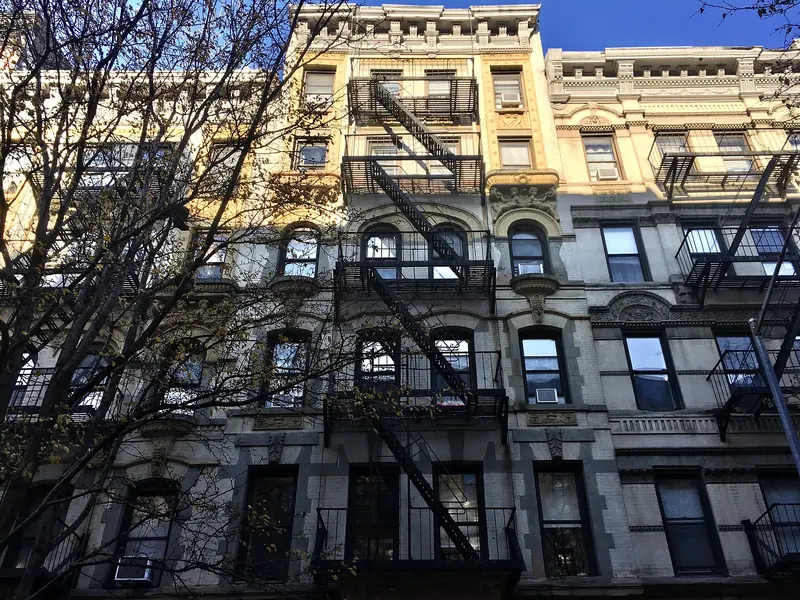
Most Manhattan homes are in apartment buildings with an elevator or with shops downstairs: start with the co-op or condo high-rise sheet. Climb stairs in an older building? Read the prewar walk-up sheet. The rare house is on the brownstone sheet.
Which buildings do Manhattan residents live in?
City Planning’s tax-lot file counts 957,517 homes in Manhattan; 83% are in elevator or mixed residential-and-commercial buildings, 15% in walk-ups and under 1% in houses. About half are in buildings recorded as built before 1940, according to DCP’s PLUTO data, version 26v2.
| DCP land use category | Residential units | Share | Sheet that fits |
|---|---|---|---|
| Mixed residential and commercial | 419,381 | 44% | Walk-up or high-rise, depending on the elevator |
| Multi-family elevator | 372,302 | 39% | Co-op or condo high-rise, or new-build condo |
| Multi-family walk-up | 144,285 | 15% | Prewar walk-up |
| One and two family | 6,066 | under 1% | Brownstone or row house |
These are unit counts from city tax records, not a survey of people, and DCP says the year built is accurate only to the decade.
When is a Manhattan building’s gas piping inspection due?
It depends on the community district number. Manhattan has 12 districts, and the DOB Local Law 152 schedule sorts them into four sub-cycles. Apart from one- and two-family houses, every building needs a Licensed Master Plumber’s inspection every four years; the Local Law 152 page explains filing.
| Sub-cycle | Manhattan districts | Some neighborhoods (DCP) | Inspection years |
|---|---|---|---|
| A | 1, 3, 10 | Tribeca, Lower East Side, Central Harlem | 2024 and 2028 |
| B | 2, 5, 7 | West Village, Midtown, Upper West Side | 2025 and 2029 |
| C | 4, 6, 8, 9 | Chelsea, Turtle Bay, Upper East Side, West Harlem | 2026 and 2030 |
| D | 11, 12 | East Harlem, Washington Heights | 2027 and 2031 |
Neighborhood names come from DCP’s Community District Profiles. Buildings with a certificate of occupancy from December 6, 2016 on wait until their tenth year.
Where does Manhattan’s tap water come from?
Upstate reservoirs, through tunnels under the borough. The CEQR Technical Manual says Croton water reaches the Bronx and Manhattan through the New Croton Aqueduct, and City Tunnels No. 1 and No. 3 both cross Manhattan. DEP says a neighborhood often gets a mix of all three upstate systems. The tap water page covers taste, hardness and lead.
Why is there a wooden tank on so many Manhattan roofs?
Pumps lift water to it. The Health Department says buildings over six floors pump water up to rooftop tanks, and owners must have each one inspected and sampled yearly, filed by January 15. See the roof tank page.
Who does what here?
In a rental, the owner answers for heat, hot water and shared pipes through the super or management company. In a co-op or condo, 311 says the governing documents split repairs between board and unit owner.
| Problem | Start with | If it is not fixed |
|---|---|---|
| No heat or hot water | Super, landlord or board | 311 complaint to HPD; DHCR form if rent-stabilized |
| Boiler due for its yearly check | Owner’s licensed inspector (6+ families) | DOB boiler compliance records |
| Gas smell | Leave the building first | 911 and your gas utility, called from outside |
| Leak from the unit upstairs | Super or management office | 311, then HP action in Housing Court |
Taller buildings often run two-pipe steam, typical at six storeys or more per the NYC Retrofit Accelerator. For a cold apartment, see the 311 heat complaint page.
Look up your own building
- HPDONLINE · open violations, heat complaints and the registered owner for your address
- DOB gas piping lookup · your community district and Local Law 152 year
- Rooftop tank results · the owner’s latest tank inspection, searchable by address or BIN
- ZoLa · lot details, including year built and number of units
- 311 · file a heat, hot water or leak complaint
Questions people ask
Does my Manhattan co-op board have to give me heat?
Yes, for the building’s central system. 311 directs heat rules to rental and cooperative building owners, and shareholders report first to the board or management. Your proprietary lease decides repairs inside the apartment.
Which district covers Marble Hill?
DCP’s data dictionary says Marble Hill is legally in Manhattan but serviced by the Bronx, in Bronx districts 7 and 8. Use DOB’s address lookup for the Local Law 152 year instead of guessing.
Are lead service lines common in Manhattan?
DEP links lead lines mostly to small buildings, under six units. Lots with one to five homes hold about 3% of Manhattan’s units, by our count of DCP data. DEP’s named free replacement areas are in the Bronx, with Brooklyn and Queens next.
Who checks a Manhattan boiler every year?
With six or more families, DOB requires a yearly inspection by a licensed inspector or insurance company, hired by the owner. Residents never work on the boiler.
Is there a Manhattan-only heat complaint count?
Not here. HPD publishes citywide totals, and no Manhattan breakdown is published in a usable form, so we give no borough figure.
How this plate was drawn
Built from DOB’s gas piping and boiler pages, DEP and Health Department water pages, the CEQR manual and City Planning’s PLUTO 26v2 data, all checked 11 Nov 2026. Housing shares are our own sums of DCP unit counts. Borough complaint counts and Census tables were out of reach.
Sources
- NYC Buildings — Periodic Gas Piping System Inspections · Local Law 152 sub-cycles and exemptions · checked 11 Nov 2026
- City Planning — PLUTO Data Dictionary 26v2 · land use categories, unit and year-built definitions, Marble Hill note · checked 11 Nov 2026
- City Planning — Community District Profiles · neighborhood names for each Manhattan district · checked 11 Nov 2026
- Office of Environmental Coordination — CEQR Technical Manual, chapter 13 · Croton aqueduct and city tunnel routes · checked 11 Nov 2026
- Health Department — Drinking Water Tank Inspection Reporting · pumped roof tanks above six floors, yearly inspection, January 15 filing · checked 11 Nov 2026
- NYC Retrofit Accelerator — Two-Pipe Steam primer · two-pipe steam in taller buildings · checked 11 Nov 2026
- 311 article KA-01074 on apartment maintenance · how co-op and condo documents split repairs · checked 11 Nov 2026
Borough sheet N-1 · revised 11 Nov 2026