B-1Building · walk-up
Living in a prewar walk-up: heat, water and repairs
In a prewar walk-up, the owner runs one boiler for every apartment, usually feeding steam radiators, and every heat, hot water and pipe problem starts with the owner or super.
- Heat comes from
- A cellar boiler sending steam up to cast-iron radiators, often one pipe per radiator
- Who controls the boiler
- The owner and the super run the boiler; tenants never touch it, its burner or its controls
- The rule that matters most
- Oct 1–May 31, 68°F by day when it is under 55°F outside and 62°F at night, plus 120°F hot water all year (HPD)
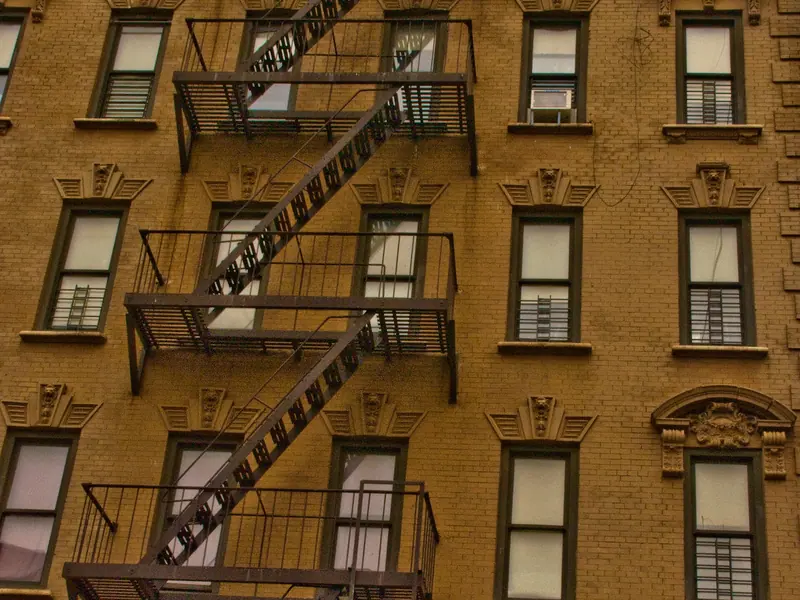
A walk-up is an apartment building you climb by stairs: no elevator, usually up to five or six storeys. With three or more households it is a multiple dwelling in city law, and that decides most of what follows. The owner carries heat, hot water and repairs; the tenant reports, gives access and avoids causing damage.
Where does the heat come from here?
Heat comes from one boiler in the cellar, usually making steam. The city’s Retrofit Accelerator says one-pipe systems turn up mostly in buildings of six stories or fewer: a single pipe takes steam up to each radiator and brings condensed water back down, while a vent on the radiator lets air escape. The primer adds that many of these old systems were built for coal, lack venting and have oversized boilers, so one flat roasts while the next stays cold. See one-pipe steam for the parts visible from your room.
Who controls the boiler?
The owner controls the boiler; the super or a hired heating firm runs it day to day. Tenants should never adjust, reset or open any part of it: DOB allows boiler work only under a permit or by a licensed oil burner installer or Licensed Master Plumber, and steam runs hot and under pressure. What a tenant can do is log the date, time and room temperature, note whether the radiator and vent hiss or stay cold, and send that to the super or owner in writing.
Which rules apply to this building?
Every multiple dwelling must get heat from a central system and hot water at every tap, under Admin Code §27-2028 and §27-2031. As of 11 Nov 2026, HPD’s minimums for October 1 to May 31 are 68°F in daytime hours whenever the outdoor reading drops under 55°F, 62°F overnight in any weather, and hot water of 120°F or more all year.
- Boiler inspection. DOB requires an annual boiler inspection where a residential building has six or more families; a walk-up of five families or fewer is exempt.
- Gas piping (Local Law 152). A walk-up’s gas piping needs a Licensed Master Plumber’s inspection every four years, timed by community district; districts 4, 6, 8, 9 and 16 are due in 2026.
- Carbon monoxide alarms. The owner installs a CO alarm within 15 feet of the main entrance to each sleeping room; the tenant tests it and changes batteries.
- Natural gas detectors. HPD lists January 1, 2027 as the date by which walk-up owners with gas piping put in at least one natural gas detector. That held on 11 Nov 2026 and could change.
- Rent rules. DHCR says rent control generally applies to buildings built before 1947 and that apartments leaving it can become rent-stabilized, so one walk-up may mix controlled, stabilized and market flats. See rent-stabilized repairs.
Who answers for what here?
The owner answers for nearly everything in the pipes; the tenant answers for damage they cause and for access. HPD says owners must provide and maintain heat, hot and cold water.
| Job | Owner / landlord | Super or management company | Tenant |
|---|---|---|---|
| Heat | Must supply it; pays for repairs | Runs the boiler, answers first | Reports in writing, then 311 |
| Hot water | Must supply 120°F all year | Checks the heater or boiler | Reports low or no hot water |
| Radiators and vents | Repairs and replaces | Has failing vents checked and replaced | Reports hissing or cold units; never touches a hot vent |
| Gas piping | LL152 inspection, LMP repairs | Calls the plumber | Never works on gas; leaves if it smells gas |
| Water and sewer bill | Pays the DEP account | Watches for leaks | Usually not billed |
| Lead service line | Owns the whole line to the main | Passes on DEP notices | Can ask for a free test kit |
| House sewer | Owns it out to the city sewer | Clears backups via a plumber | Reports backups |
| Leaks between floors | Fixes pipes and ceilings | Finds the source fast | Reports at once, gives access |
What goes wrong most in a walk-up?
Most walk-up trouble is steam: knocking pipes, one cold radiator, a vent that hisses all night. See banging radiators, a cold radiator and radiator air vents, and report what you see to the super. If the whole building is cold, go owner first, then 311, as in filing a heat complaint.
The other is gas. After a leak is found, gas can stay off for days while the owner’s Licensed Master Plumber files with DOB and the piping is tested; see gas shut off in the building. Smell gas on the stairs or in your kitchen? Get out of the building with your neighbors, leaving switches, phones and doorbells untouched, and only once you are outside and well away call 911 and your gas utility, Con Edison or National Grid, as named on your bill.
Look up your own building
- HPDONLINE · open heat and hot water violations, complaint history and the owner’s registration for your address
- DOB gas piping inspections · whether your building is on the LL152 list and its due year
- NYC ZoLa · year built, number of units and community district for your lot
- DEP lead and drinking water · links to the NYC Service Line Map showing the recorded material of your service line
- 311 · heat, hot water and maintenance complaints when the owner doesn’t fix them
Questions people ask
Does my walk-up need an annual boiler inspection?
Only if it has six or more families. DOB exempts boilers in residential buildings of five families or fewer. Your owner hires the inspector and files the report; tenants have no part in it.
Who replaces a hissing vent in a walk-up?
No. We found no primary source treating a vent swap as a resident job, and steam radiators run hot. Tell the super whether the vent hisses, spits or stays cold.
One flat is cold while the next is hot. Does that count?
Yes: the minimums apply inside each unit, not as a building average. If your rooms fall short, tell the owner in writing, then file with 311.
How can a walk-up tenant tell if the flat is rent-stabilized?
Owners register stabilized apartments with DHCR each year and must give each tenant a copy of that registration. If none ever arrived, ask the owner in writing, or ask DHCR.
Who pays the water bill in a walk-up?
The owner’s DEP account covers the building. With four or more units it may be on a flat charge of $1,412.60 per unit a year from July 1, 2026, instead of a meter.
How this plate was drawn
Built from HPD’s heat pages, the Housing Maintenance Code as DOB compiles it, DOB’s boiler and gas piping pages, the Accelerator steam primer and DHCR’s rent publications, checked 11 Nov 2026. "Walk-up" here means an older stair-only building of three or more flats; ZoLa and HPDONLINE show your real unit count and age. No citywide count of walk-ups, or of those still on one-pipe steam, turned up, so none is given.
Sources
- HPD — heat and hot water · walk-up minimum temperatures and hot water · checked 11 Nov 2026
- DOB — Housing Maintenance Code · why a walk-up is a multiple dwelling · checked 11 Nov 2026
- DOB — boiler compliance · the six-family line for walk-up boilers · checked 11 Nov 2026
- DOB — gas piping inspections · LL152 district years for walk-ups · checked 11 Nov 2026
- Retrofit Accelerator — one-pipe primer · walk-up steam and uneven heat · checked 11 Nov 2026
- HPD — detectors · walk-up CO alarm and gas detector duties · checked 11 Nov 2026
- NYS HCR — FS-01, rent regulation · pre-1947 control, registration copies · checked 11 Nov 2026
- HPD — tenant rights · what walk-up owners must maintain · checked 11 Nov 2026
Building sheet B-1 · revised 11 Nov 2026