H-8Heat · cold radiator
Why is my radiator cold when the heat is on?
A cold radiator in a New York steam building usually means steam isn’t reaching it: trapped air, a clogged vent or trap, a closed valve, or a boiler cycle too short to fill the far end of the system.
Which building is yours?
- Prewar walk-upTell the super or owner first, with the room and times. If the flat is below 68°F by day (under 55°F out) or 62°F at night, file with 311.
- Brownstone or row houseOwner-occupied single-family: no city heat rule applies, so call a licensed plumber or heating pro. Renting a unit? The owner must heat it; tell them.
- Co-op or condo high-riseTell the super or management. Heat is a building-wide service; who pays for a repair inside the unit depends on the proprietary lease.
- Two-family houseThe tenant’s unit is covered by the heat rules. Tell the owner first, then 311 if it stays cold; the owner hires the licensed pro.
- New-build condoHeat from equipment inside your unit? The condo documents decide who repairs it. A cold radiator on a central boiler goes to management.
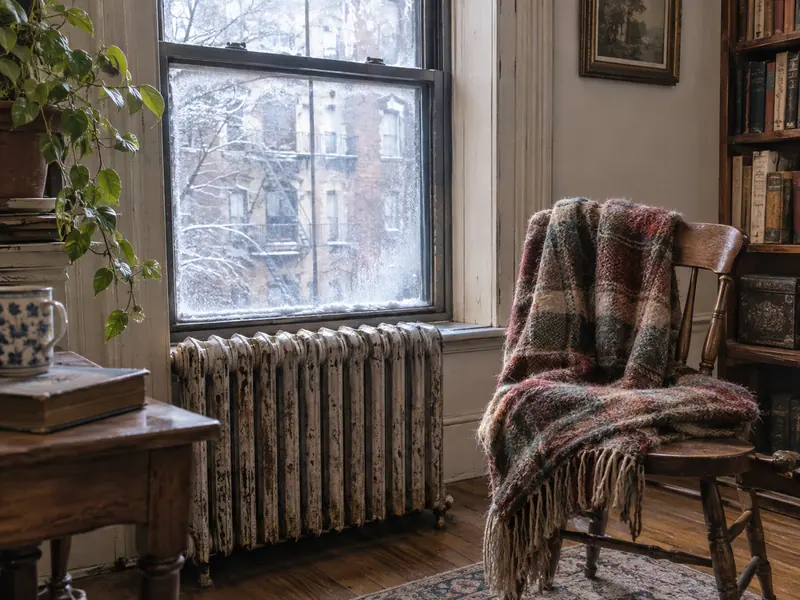
Start with who controls the heat. In a rental walk-up or high-rise it is the owner, through the super. In a co-op or condo it is the board, through management and the super, with the building’s own papers deciding who pays for what inside the unit (311 apartment maintenance). In a house you own and live in alone, it is you and the licensed pro you hire. The building sheets go into each type in more detail.
When is a cold apartment against the rules?
From October 1 to May 31, the owner of a covered building must keep the inside at 68°F or warmer between 6am and 10pm on any day the outdoor reading is under 55°F, and at 62°F or warmer overnight in any weather (HPD heat and hot water). The rules cover every building with three or more apartments and any one- or two-family house with a tenant. One cold radiator in a warm flat may not break the rule; a cold flat does. Our heat season rules page has the full detail.
| Building | Covered by city heat rules? | First call | Next step if nothing changes |
|---|---|---|---|
| Prewar walk-up | Yes | Super or owner | 311 heat complaint; DHCR if rent-stabilized |
| Brownstone or row house | Only if a unit is rented | Owner-occupied: licensed pro; tenant: the owner | Tenant: 311 |
| Co-op or condo high-rise | Yes | Super or management company | 311; the board |
| Two-family house | Yes, for the tenant’s unit | Tenant tells the owner | 311 |
| New-build condo | Yes as a building; unit equipment varies | Management, or the unit owner if equipment is in the unit | 311 for building-wide heat |
Why does a steam radiator stay cold?
Steam has to push air out before it can fill a radiator, and it has to reach the radiator before the boiler shuts off. The sources we rely on name these causes:
- A clogged or painted-over air vent. The US Department of Energy’s balancing guide traces many cold apartments to radiator vents that have stopped passing air, often because someone painted over them (US DOE Building America guide). See radiator air vents.
- A closed or half-open radiator valve. The same guide says that if no steam ever reaches a radiator, the valve should be checked; a partly closed valve keeps water in the radiator and steam out.
- Too little venting on the mains. Without enough main-line vents, radiators nearest the boiler fill much faster than distant ones, especially if the boiler shuts off before the system is full.
- Where the thermostat sits. If the building’s sensor is in a warm spot, the DOE guide says the boiler may stop before colder units are satisfied.
- A failed trap, in two-pipe systems. Weil-McLain’s troubleshooting chart lists traps (two-pipe) or vents (one-pipe), wrong pressure settings, and clogged piping or a closed valve when some radiators don’t heat, each for a qualified service technician (Weil-McLain steam boiler troubleshooting). See two-pipe steam.
The city’s Accelerator primers add a cause on the resident’s side: an obstructed radiator. They say staff should explain why not to block radiators and how to report heating problems (NYC Accelerator two-pipe primer).
What should you note before you call?
Notes turn "my radiator is cold" into something the super can act on:
- which room and radiator, and whether it is fully cold or warm at one end;
- the indoor temperature and the time, ideally on several days;
- whether the vent hisses, whistles, spits or stays silent when the heat comes on;
- whether the valve handle looks open, without turning it;
- whether anything is covering or pushed against the radiator;
- whether neighbours on the same line are cold too.
What if the owner doesn’t fix it?
Tell the owner or super first, as HPD advises, then file a heat complaint through 311 by phone, online or the app. HPD tries to reach the owner, calls you back, and sends an inspector if the problem isn’t fixed. Heat violations are Class C, to be corrected immediately, with civil penalties of $350–$1,250 a day for a first violation issued on or after Dec 8, 2023 (HPD Heat Sensors Program).
Rent-stabilized tenants can also apply to DHCR for a rent reduction, which needs an HPD report finding the heat failure (rent-stabilized repairs). An HP action in Housing Court is the other legal route. Stopping rent payments is not one of them: HPD says withholding rent may lead to eviction.
Legend: the numbers on this plate
- 68°F / 62°Fdaytime and overnight floors, October through Mayminimums in the HMC
- $350–$1,250daily range for a first heat violation (issued from Dec 8, 2023)housing code penalties
- Apartment or buildingthe two kinds of 311 heat complaint311 heat article
Look up your own building
- HPDONLINE · heat complaints, violations and any heat litigation for your building
- 311 heat or hot water complaint · filing an apartment or building-wide heat complaint
Questions people ask
My radiator is cold but the room is warm. Is that a problem?
For the law, the indoor temperature is what counts, not each radiator. It can still be worth reporting, since a cold radiator may point to a vent or valve fault that gets worse.
Should a tenant open the radiator valve all the way?
The DOE guide says tenants should typically not tamper with radiator valves. Note whether it looks open and tell the super; valves on steam radiators can be hot and may need replacing rather than turning.
Does the heat law cover a house the owner lives in alone?
No. The heat rules cover multiple dwellings and one- or two-family houses with a tenant. An owner living alone in a one-family house calls their own licensed plumber or heating pro.
Can a rent-regulated tenant replace the radiator or its parts?
Not without the owner’s written permission, according to New York State Homes and Community Renewal, because the owner must maintain the equipment.
Who fixes a cold radiator in a co-op apartment?
Report it to the super or management. Heat is a building service, but the proprietary lease decides whether a repair inside the apartment falls on the board or the shareholder.
How this plate was drawn
Put together from HPD’s heat, sensor and HPDONLINE pages, 311’s heat and maintenance articles, NYS HCR, the DOE Building America balancing guide, the NYC Accelerator two-pipe primer and a Weil-McLain boiler manual, checked 11 Nov 2026. HPD’s main heat page still lists the older, lower penalty figures; we use the amounts in the code and on the sensor page. Cold rooms in buildings with per-unit heat pumps or electric heat are only touched on. The Pennsylvania firm in the store block works outside New York and is an example, nothing more.
Sources
- NYC HPD — Heat and Hot Water · indoor minimums, landlord first, inspections · checked 11 Nov 2026
- NYC HPD — Heat Sensors Program · current penalty amounts · checked 11 Nov 2026
- US DOE Building America — steam balancing guideline, radiator vents section · vents, valves, main venting, thermostat placement · checked 11 Nov 2026
- Weil-McLain — steam boiler troubleshooting chart (SGO) · reasons some radiators don’t heat · checked 11 Nov 2026
- NYC Accelerator — two-pipe steam primer, June 2021 · obstructed radiators, reporting heating issues · checked 11 Nov 2026
- NYS HCR — essential services for rent-regulated tenants · tenant may not replace owner equipment · checked 11 Nov 2026
- DHCR heat and hot water guidance, December 2022 · the HPD report a DHCR heat complaint needs · checked 11 Nov 2026
- Housing Maintenance Code §27-2029 and §27-2115, compiled by DOB · minimums and penalty range · checked 11 Nov 2026
- 311 — apartment maintenance, co-ops and condos · board or unit owner by agreement · checked 11 Nov 2026
Plate H-8 · revised 11 Nov 2026